Eunice Newton Foote was a nineteenth-century American inventor and independent scientific researcher whose contributions to climate science were overlooked for more than a century. She was among the earliest scientists to experimentally demonstrate the heat-absorbing properties of carbon dioxide and to suggest a connection between atmospheric composition and Earth’s climate.
Born in 1819 in Connecticut, Foote received her education at the Troy Female Seminary, one of the few institutions at the time to offer women formal training in science. At a time when women were largely excluded from scientific institutions, she pursued experimental research independently, conducting studies in physics and atmospheric science with remarkable rigor and originality.
In the mid-nineteenth century, as industrialization intensified coal use and air pollution, scientists began to explore the relationship between the atmosphere and temperature. While Joseph Fourier had earlier proposed that the atmosphere could retain heat, experimental evidence remained limited. Several years before John Tyndall’s widely recognized infrared experiments, Foote conducted comparative studies showing that carbon dioxide absorbed significantly more heat than ordinary air.
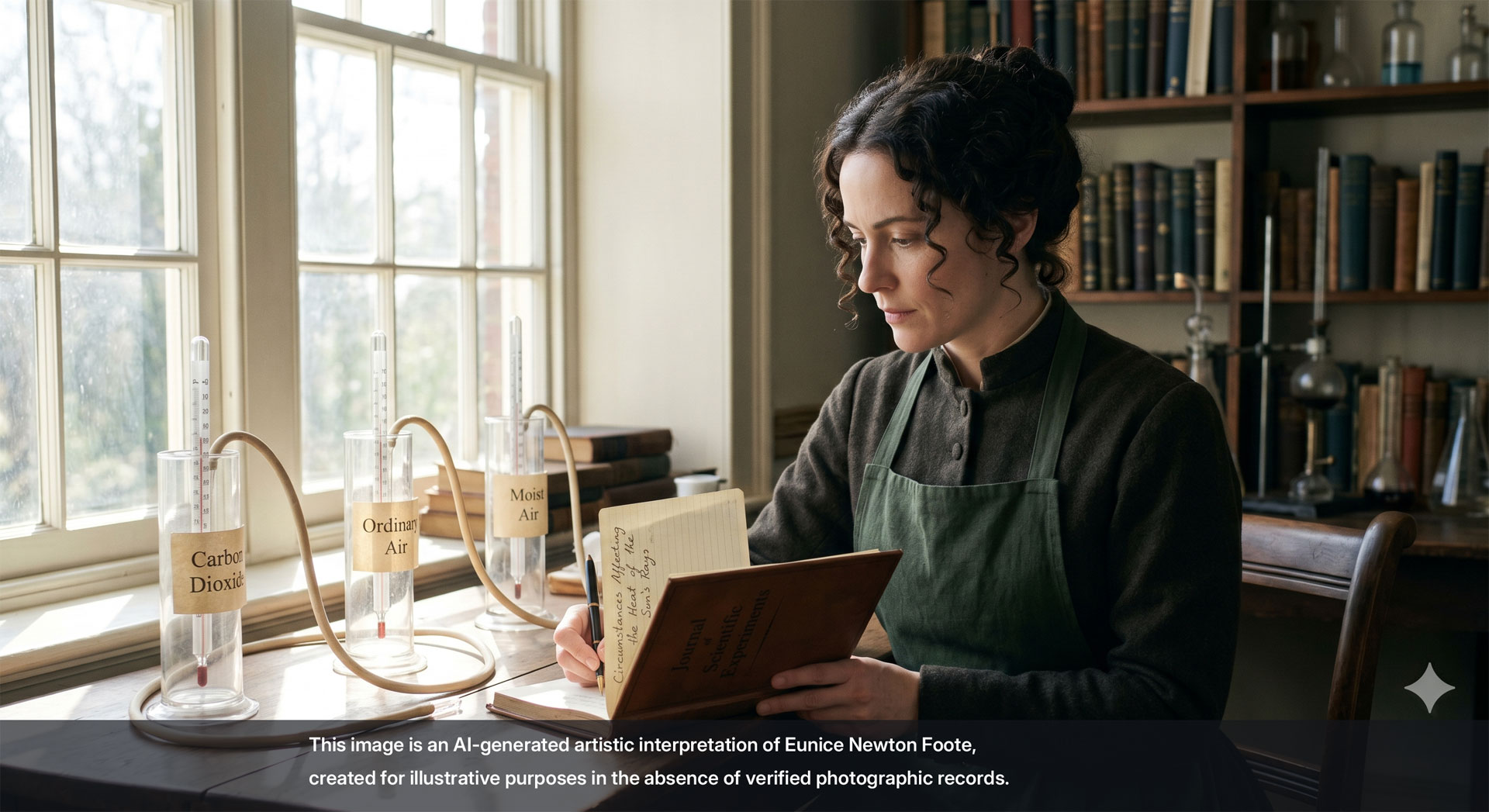
Using simple apparatus available to her, Foote compared the thermal behavior of dry air, moist air, hydrogen, and carbon dioxide when exposed to sunlight. She observed that carbon dioxide not only reached higher temperatures but also cooled more slowly, indicating its strong heat-retaining properties.
Importantly, Foote went beyond experimental observation. She proposed that if the concentration of carbon dioxide in Earth’s atmosphere had been higher in the past, it would have led to a warmer global climate—a hypothesis now recognized as one of the earliest scientific links between atmospheric CO₂ levels and global warming.
In 1856, Foote submitted her paper, Circumstances Affecting the Heat of the Sun’s Rays, to the American Association for the Advancement of Science. As women were not permitted to present at the meeting, her work was read on her behalf by Joseph Henry. Although her paper was published later that year, it did not receive significant attention and was gradually forgotten as climate research advanced.
Her contributions were rediscovered in the twenty-first century, leading to renewed recognition of her role in the history of climate science. Today, Eunice Newton Foote is acknowledged as a pioneering figure whose work laid early experimental foundations for understanding the greenhouse effect.
Foote Technology Limited takes its name in tribute to Eunice Newton Foote’s scientific integrity, independence, and perseverance. Her legacy serves as a reminder that credible science, grounded in evidence and long-term thinking, remains essential to addressing the challenges of climate change today.