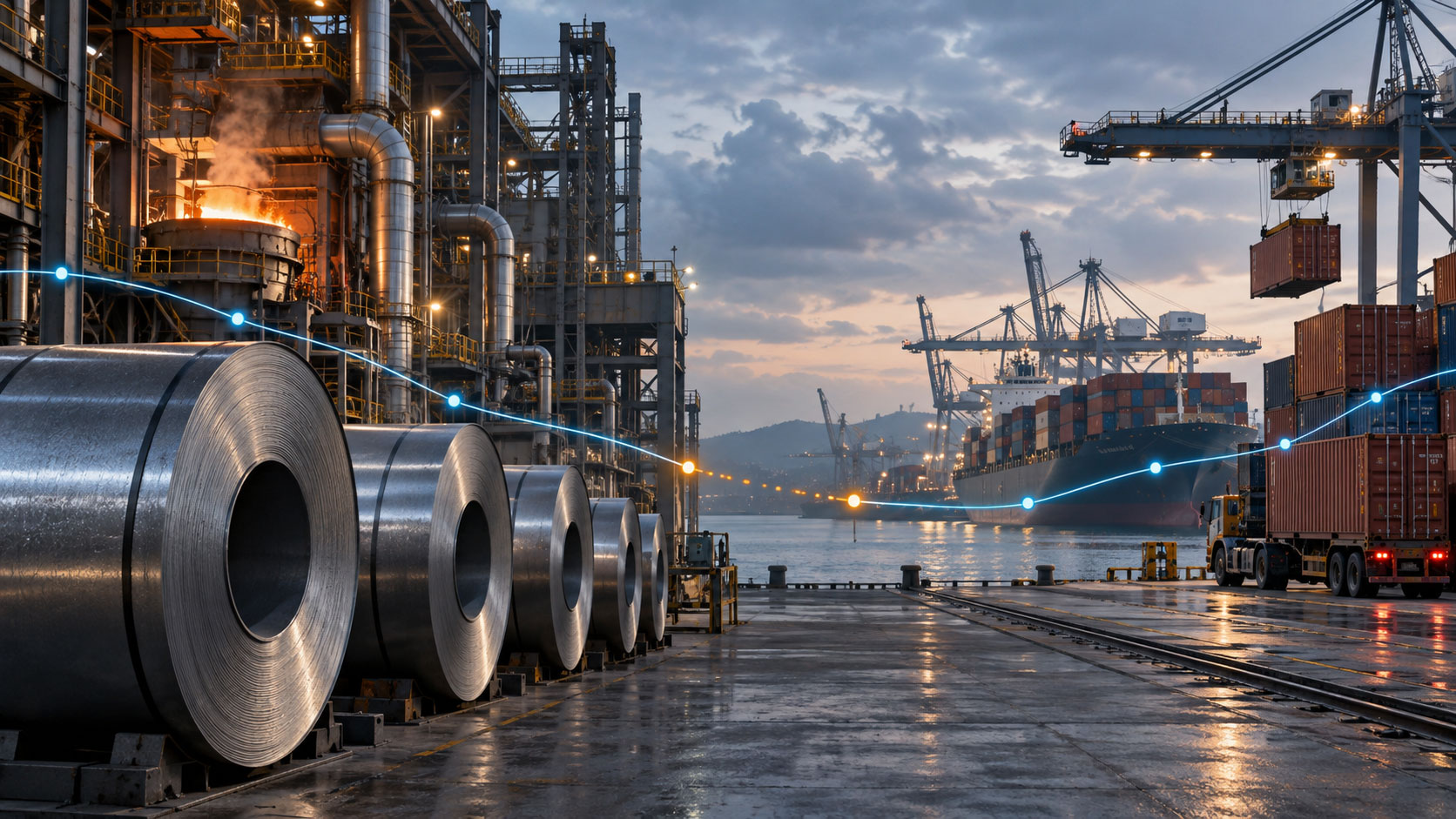
Now that the EU Carbon Border Adjustment Mechanism (CBAM) has entered its definitive regime, the difference between a tonne of carbon that is cut and one that is recognized has acquired a price.
For supply chain leaders, this creates a new problem. An EU importer may depend on emissions information generated several steps upstream, while a supplier that has genuinely reduced emissions may still struggle to show how those reductions changed the embedded emissions of the goods being sold. Carbon performance is becoming more than a sustainability metric. It is becoming a product attribute, and the evidence supporting it is becoming part of the supplier relationship.
Consider a producer that upgrades a furnace, recovers waste heat, and reduces its natural-gas consumption. The engineering result may be clear at plant level. But CBAM concerns emissions attributed to particular goods under prescribed boundaries and calculation rules. If energy records, production volumes, and product routes sit in different systems, the supplier may struggle to show how the improvement changed the embedded emissions of products exported to Europe, especially when products share utilities or production mixes change.
This is recognition risk: a genuine emissions reduction can lose economic value because it cannot be attributed, reconstructed, and verified at the level where the claim ultimately matters.
Recognition risk is becoming procurement risk
Recognition risk changes how companies should evaluate both decarbonization investments and suppliers. A business case that counts tonnes saved but does not establish whether those reductions can be reflected in the embedded emissions of products sold may overstate the project’s regulatory and commercial return. Two suppliers may achieve similar physical reductions yet create different value for customers if one can substantiate them at product level and the other cannot.
Procurement teams increasingly need to ask not simply, ‘What is your product carbon footprint?’ but also how the figure was produced, what records support it, how allocation rules were applied, what changed from previous reporting periods, and whether the calculation can be reconstructed during verification.
That has practical implications across supplier management. During supplier qualification, companies may need to assess whether a supplier can generate reproducible product-level emissions evidence rather than simply provide a final carbon number. Contracts may need to address calculation methods, data-quality requirements, correction procedures, methodology changes, and verifier access. During supplier performance management, companies may increasingly track the continuity and traceability of carbon evidence alongside price, quality, and delivery.
A contract requiring only a final emissions figure may prove inadequate if neither the buyer nor an independent verifier can establish how it was produced. Better data does not automatically reduce CBAM liability; any reduction must still fall within the relevant product boundary and applicable methodology. But inadequate evidence can prevent a genuine operational improvement from being reflected in the embedded emissions ultimately declared for the relevant goods.
The challenge grows when emissions originate further upstream. A downstream manufacturer may operate efficiently while inheriting substantial emissions through steel, aluminum, or other precursor materials. Supplier carbon performance can therefore affect downstream embedded emissions and, where applicable, the buyer’s CBAM exposure.
Carbon is becoming a procurement attribute alongside quality, origin, and delivery reliability, but with one critical difference: it cannot be observed in the finished product. A buyer cannot inspect a tonne of steel and determine its embedded emissions. The claim depends on an evidence chain linking operational data, production records, calculation rules, and allocation decisions.
The goal is proof without surrender
There is an obvious tension: buyers need better evidence, but demanding complete transparency from suppliers is neither realistic nor desirable. Energy consumption, production volumes, operating conditions, and process efficiency can reveal technical know-how, production economics, and other commercially sensitive information. The practical objective should therefore be proof without surrender.
A supplier should be able to substantiate a product-level emissions claim without giving customers unrestricted access to its operational databases. Buyers need sufficient evidence to support confidence and verification, while suppliers retain control over sensitive information. This is as much a supply chain governance problem as a carbon-accounting problem.
Companies must determine what information needs to move between organizations, what can remain under the supplier’s control, who may inspect it, and how corrections and methodological changes are documented. The goal is not unlimited transparency, but sufficient, traceable evidence for a claim to be tested.
Common rails, not one platform
Spreadsheets and PDF reports are often poorly suited to this task because they are difficult to reconcile across reporting periods, corrections, and organizational boundaries. Forcing every supplier onto the same carbon-accounting platform is equally unrealistic. Global supply chains use different ERP, manufacturing, energy-management, and sustainability systems, so a more credible direction is interoperability.
The Partnership for Carbon Transparency (PACT), for example, is developing a common basis for calculating and exchanging product carbon footprints across different technology solutions. Catena-X is establishing common rules and technical frameworks for interoperable, data-sovereign exchange of product carbon footprint data across industrial supply chains.
Neither initiative resolves CBAM compliance on its own. Their importance is architectural: common definitions and interfaces can allow information to move between organizations without requiring every participant to adopt the same software platform. Interoperability alone, however, is not enough. Companies must still preserve the relationship between source records, calculation rules, corrections, approvals, and the final reported result. Otherwise, a number may move efficiently through the supply chain while the evidence needed to trust it remains behind.
In our recent peer-reviewed research on decentralized MRV and carbon-data governance, we examine one approach to maintaining this source-to-claim traceability while allowing sensitive operational records to remain under the control of the organization that generates them. The broader principle is important for supply chains: trusted exchange does not require all participants to surrender their raw data or operate on the same platform.
A supply chain issue, not just a reporting issue
CBAM readiness therefore cannot sit only with sustainability, tax, or customs teams. It increasingly connects capital investment, plant operations, product accounting, procurement, information governance, and assurance. These functions need to agree not only on the final emissions number, but also on who owns the evidence, how it is maintained, and how another party can test the claim without unrestricted access to sensitive information.
For supply chain leaders, the opportunity is larger than compliance. Companies that build these connections can compare suppliers on evidenced carbon performance, incorporate carbon more credibly into sourcing decisions, and evaluate decarbonization investments against the economic value they can actually produce. Suppliers that invest in cleaner production also have a better chance of ensuring those improvements remain commercially visible downstream.
As carbon increasingly enters purchasing, contracting, and supplier-management decisions, the competitive question will not simply be which supplier emits less. It will also be which supplier can prove it.
Those that fail to build the evidence chain may discover that a furnace has cut emissions, while the corresponding tonne has disappeared somewhere between the factory floor and the border.