An earlier version of this article was published by Eco-Business. This expanded version is republished with permission.
Carbon markets have expanded rapidly, yet they still lack much of the transparency, comparability and price-discovery infrastructure associated with mature financial markets. Concerns over credit quality remain common, and many financial institutions remain cautious.
These market limitations are often attributed to inconsistent standards, insufficient liquidity or the early stage of market development. Those factors matter, but they do not address a more fundamental constraint: how carbon data is generated, governed and verified.
Carbon markets are financialising environmental outcomes faster than the supporting data infrastructure is being built. Yet much of the evidence beneath carbon credits is still produced through systems designed for periodic compliance reporting and project certification.
The question is not only whether a credit complies with a methodology. It is whether the supporting data can provide the trust required when an environmental claim becomes a tradable, investable or finance-linked asset.
From traditional MRV to financial-grade MRV
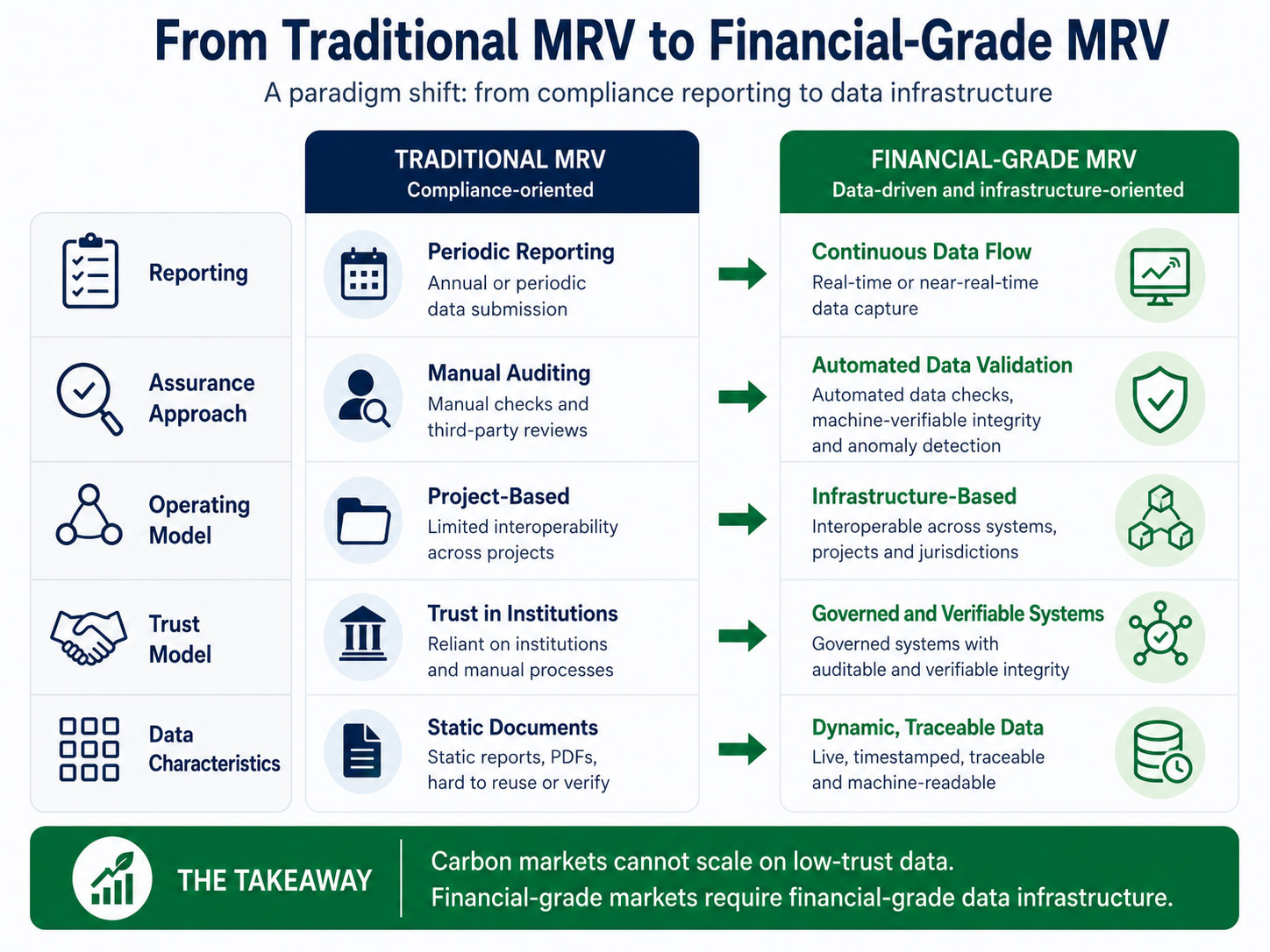
Measurement, reporting and verification (MRV) systems determine how emission reductions and removals are quantified and converted into environmental claims or credits. Traditional MRV was designed for regulatory reporting and periodic project certification. That design becomes limiting when credits are expected to behave like financial assets.
Established financial markets continuously record ownership and transactions, supported by standardised disclosure and reconciliation. Carbon markets increasingly adopt this transaction layer, but the evidence beneath many credits remains periodic and document-based.
The underlying mitigation activity may continue throughout the year, while the supporting evidence is assembled months later through monitoring reports and periodic verification. Between verification cycles, buyers and investors may have limited visibility into whether the activity is continuing, how conditions have changed and where risks may be emerging.
This creates a structural mismatch: carbon credits are expected to function as financial assets, while the systems generating the evidence remain largely compliance-oriented.
Financial-grade MRV does not mean that every data point must be independently verified in real time. It means that the data architecture can provide continuity, standardisation, traceability, auditability and risk visibility when environmental outcomes support commercial or financial use.
The figure below highlights the differences between traditional MRV and financial-grade MRV.
Standards bodies are beginning to digitise methodologies, submissions and verification workflows. These developments can improve efficiency, but they do not by themselves govern how evidence is generated, corrected and controlled before entering a methodology or registry process.
Moving towards financial-grade MRV therefore requires more than digitising forms. It requires a shift from periodic reporting to continuously governed data infrastructure. Carbon data must be treated not as a static reporting output, but as a governed data asset with a durable record of where it came from, how it changed and how the final claim was calculated.
Carbon-market trust begins with real-world data
Discussions about carbon markets often focus on methodologies, registries, issuance and trading platforms. These are important, but they sit downstream of the activities that generate environmental outcomes.
Every carbon credit begins with a real-world activity—industrial operations becoming less carbon-intensive, methane being captured, forests being protected or carbon dioxide being removed and stored. For industrial decarbonisation projects, the evidence base typically includes equipment operation, energy use, production output and process conditions.
Consider a biomass-based steam project in Asia-Pacific, where renewable heat displaces fossil-fuel-based steam generation at an industrial facility. The credibility of the claimed reduction depends not only on the reported volume of steam, but on the relationship among biomass characteristics, fuel displacement, plant output, operating hours, meter performance and the applicable methodology. A change in biomass moisture, boiler efficiency, production load or meter performance can alter the emissions outcome even when reported steam output appears unchanged.
The same principle applies across project types: the credibility of a claim depends on how accurately the underlying activity or environmental change is measured and translated into a quantified reduction or removal.
A registry can record the issuance, transfer and retirement of a credit. It cannot determine by itself whether the supporting data is complete, accurate and representative of the underlying project activity and environmental outcome.
The credibility of a carbon credit is therefore built further upstream—where the underlying data is collected, governed and checked—not only where credits are issued or traded.
Better data does not guarantee liquidity or premium pricing. It can, however, reduce information asymmetry, improve due diligence and make project risks easier to assess.
The missing data layer
A practical MRV infrastructure must capture source data; standardise, validate and version it; preserve traceability between records, assumptions, calculations and reported outcomes; and make governed data available for downstream applications.
Connected sensors, scalable data processing and tamper-evident records can support these functions, but coherent data governance matters more than any single technology. Our peer-reviewed research proposes one possible architecture using IoT, scalable data processing and blockchain-based integrity controls.
Building on this research, the figure below presents a simplified MRV data infrastructure showing how real-world evidence is captured, governed and assured before supporting downstream environmental and financial applications.
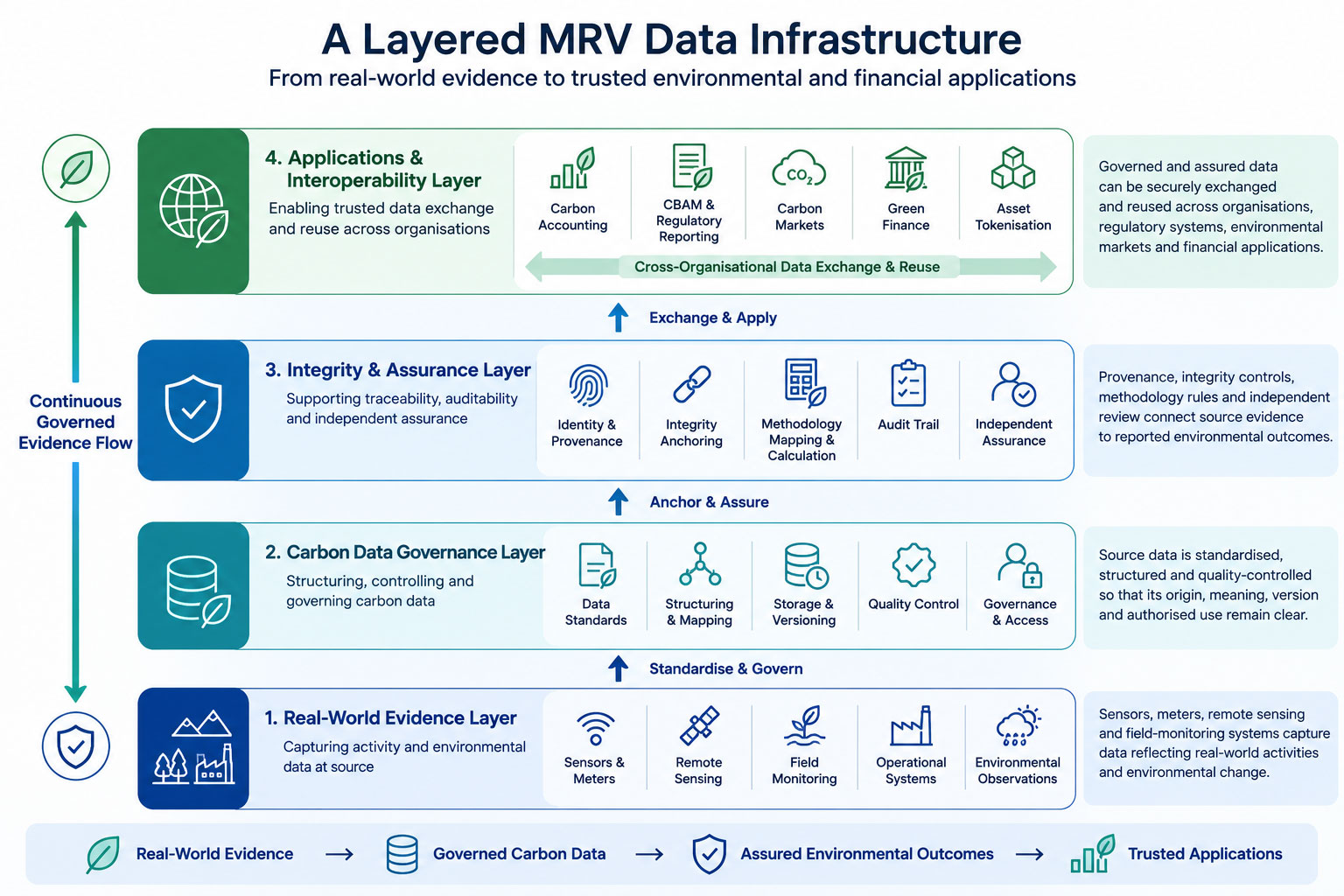
For a manufacturer supplying international markets, much of the same operational data may be required for product carbon footprints, CBAM reporting, customer reporting requirements and carbon-credit development. When each application relies on a separate spreadsheet, reporting template and verification process, companies duplicate work and risk producing inconsistent claims from the same underlying activity.
A governed data foundation can instead support these applications—as well as carbon accounting, green finance and tokenisation of environmental assets—while calibrating the level of assurance to each use case.
Tokenised climate assets still need trustworthy data behind them
Blockchain can preserve records and improve transaction traceability, but it cannot determine whether an original meter reading, assumption or monitoring report was accurate. For tokenised climate assets, trust must extend beyond the connection between a token and a registry—from the token to the claim, from the claim to the calculation, and from the calculation to the activity that produced it.
Tokenisation without reliable MRV merely digitises an asset without necessarily strengthening the evidence beneath it.
Conclusion
CBAM, product-level carbon reporting, supply-chain traceability and Article 6 are increasing expectations for data quality, traceability and due diligence. MRV is moving beyond periodic reporting and becoming part of the infrastructure connecting real-world environmental action with markets and financial applications.
By strengthening the evidence available for verification, reducing information asymmetry and making environmental risks more visible, this infrastructure can create stronger foundations for broader market participation.
The future of carbon markets will not be determined only by who issues the most credits. It will also depend on who builds the most trusted data foundations beneath them.
Research foundation
This article builds on our peer-reviewed research published in Frontiers in Climate.
Building the trusted data layer
Foote Tech develops digital MRV and carbon data governance infrastructure connecting real-world activities, environmental performance and downstream applications.